Monday, February 13, 2012

Building a Cardboard Boat

Well, I haven't lost my mind. I've actually come to my senses. The idea is to design a boat in corrugated cardboard.  It couldn't be simpler. Boat designers spend a lot of time of time planning how to build a boat. They draft or they make models, both very time consuming. I know, I've been there.

Boat design, even for the smallest craft, is actually quite complicated. One of the problems deals with a drafting term called "true view." A boat hull is generally made from plywood which is bent or curved. This creates a twofold challenge: first, how to draw a curvalinear three dimensional object on flat paper. The second problem is how to determine what all of those curved components look like when they laid out on flat plywood in the shop.

Granted, there is computer software that does all this, but it is not cheap. On the other hand, one can make a scale model, but sometimes it is difficult to work these components up to full scale. A quarter inch can mean a lot when putting together plywood, but numbers that small are not always seen in the scale model.

The cardboard model is, of course, exactly the same size as the intended boat: no need for special software, no need to scale up from small to large. Along the way, I learned a lot about drafting out a boat (called lofting in the nautical business), bending and unbending, and fitting everything together as well. It only took a few hours to do. Along the way, I made a lot of small changes that will greatly improve the performance of this boat.

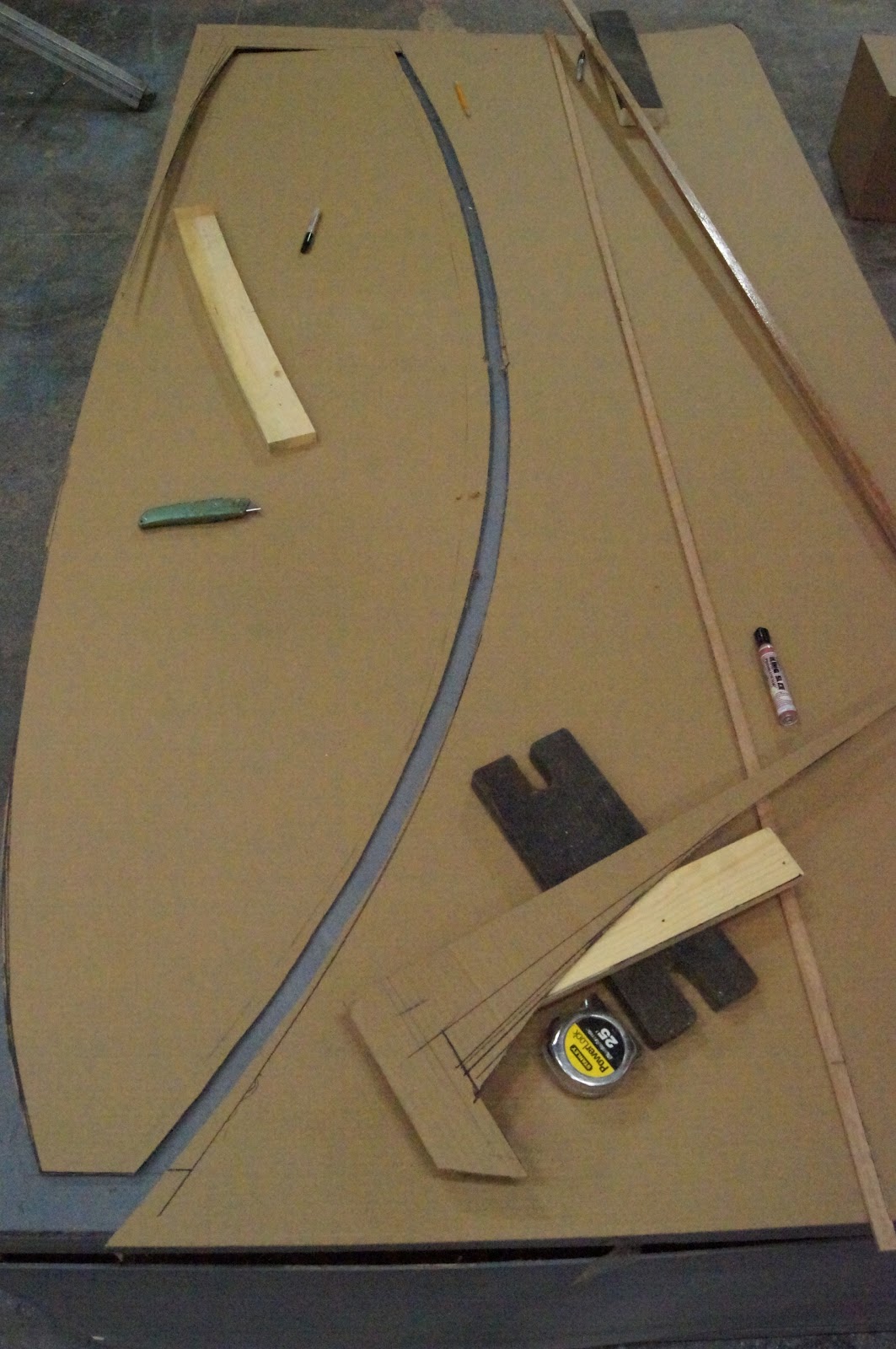
I begin by drafting the two bilge panels and cutting them  out.  The curves are drawn with  a spline  made from  half  inch mahogany

I tape them together along the center  line which has been cut  along a  gentle curve.

Then the panels are unfolded. Note that the stem is raised about 7 inches above the  work  table.  This  is a desirable hull feature in hull design called the rocker.  I know from experience that seven inches will keep the stem above the waves.

Next I add a stem, stern, and side strakes. The strakes are about  10 1/2 inches high.  Experience tells me this is about right. Too high and they catch the wind ( windage) too low and the boat could be swamped in rough water.  A temporary cardboard bulkhead is places in the center to support the hull shape.


The model still has a way to go. You may notice that I wrote out a couple notes on some of the components. I intend to do more cutting and trimming. 

When finished, this will be the dinghy that my summer class will build. I will transfer the work onto luan templates which they can copy.  See you then!


Friday, January 27, 2012

A Fast, Light Pulling Boat Part Two: Finishing Touches

I'm near completion, just a couple more tweaks which I will save until spring. Hope you enjoy the photos.
A coat of paint or two is spread on the bottom. The top strakes and the transom  are left  bright (with no stain) and varnished clear
The inside is also painted. I normally wouldn't do this, but  it  will be a nice way to show off the custom built rowing unit. The two mahogany bulk heads (or ribs) are placed a little forward and a little aft of the original specifications. This will allow for the seats to be relocated to distribute the weight more evenly.
The completed shell seen from a different angle. The Annapolis Wherry is as elegant as it is functional.
The wherry with the rowing unit mounted in place. It rests directly on the bulkheads in order to lower the center of gravity and render the boat more seaworthy. The rowing seat is clamped at the exact center of buoyancy. Unlike standard rowing units, the outriggers are designed to unlock and swing inboard for docking or transportation.
A closeup of the passenger's seat. Note how the entire unit can be clamped in place  without  using any tools.
The seats are curved along the same radius as the boat hull. The two thumb screws  can be loosened  so that the  seat can be repositioned.

The rear seat will also serve a second function when the rower is alone. If you have been reading this blog, you may have noticed that a lot of the city lakes are connected by narrow bridges and channels, rendering oars useless. So, to negotiate these waters, the rower can stow the oars inside the boat, move to the rear, and paddle the wherry like a canoe.
The forward bracket is also clamped in place with a thumbscrew. No tools required!

The Annapolis Wherry has proved to be a lot of fun. Along the way, I have learned something about myself: I enjoy building boats as much as I enjoy rowing them!

The details about my boat building class should be published next week. If you are interested, feel free to check back then.

The boat is supported by an extra long trailer. I bought an older model on Craigslist and welded on an extra five feet.


Saturday, January 14, 2012

A Fast, Light Pulling Boat Part One: Under construction

I have been pretty happy with my little dinghy. It is easy to transport, quite seaworthy, and easier to row than the larger city issue fiberglass boats. But the dinghy has it's short comings. I've always wanted a fast, light pulling boat, something that can move through the water more easily.

So when I saw an ad for an Annapolis Wherry kit on Craigslist I jumped at the opportunity. It has flawlessly good lines, is quite sea worthy, and, even though it's almost eighteen feet long, it weighs only 65 lbs- the same as the eight foot dinghy!

As it turned out the kit was badly damaged. The owner had copied the shapes parts on to mahogany then proceeded to ruin those pieces as she cut them out. But, in spite of all those problems, the price was right! So, I bought it and put it into storage waiting for winter to come. I began by sorting the pieces and deciding how to salvage the project. To make a long story short, I've pretty much succeeded and made some changes to the original design.

The Wherry under construction: There will be no fixed seats
You may have read the previous blog about building a rowing unit. The plan is to install it in the wherry. The original plans called for fixed seats with a rowing unit mounted over the top of them. It struck me as a little strange so this new boat will not have fixed seats, just a rowing unit with two seats fastened to the  monorail. I should save a couple of pounds along the way.

putting a coat of epoxy on the outside


The entire boat is finished with epoxy from Polygem. The product is safer and greener than the other stuff.  I think it took about a gallon and a half. The hull gets its strength from the filets which join each strake to the next. The filets are actually stronger than the wood surrounding them. Epoxy and lapstrake construction seem to have been made for one another.

A layer of fiberglass is also epoxied on the bottom strakes both inside and out. This adds still more strength and protects the woodwork from scuffs and scrapes. Everything sets up perfectly clear and you can't see the glass cloth. No one uses polyester resin anymore. I should be able to finish some time soon. Call it "part two." I'll post more photos then.


Sunday, January 8, 2012

Basic Boating as a College Course

I am pleased to report that I will be teaching boat building this summer at Concordia University through the office of Continuing Education. The registration details and numbers are posted below. The nice part is that it will be offered during the first half of the summer session. You will have time to take it out on the water!

One need not have any special skills or background to build a stitch and glue boat. The entire approach is geared for beginners. You will have completed a nice little 8 foot pram or dinghy by the end of the course. Feel free to bring a friend with you to help get things done. It's more fun that way!

My friend Rachel helped me with The Prodigal. We had a great time time. You can see this boat (and Rachel too) throughout this blog
After you finish, you will need to take your boat home. You could put it on a car top if you get a roof rack or borrow a pick up truck. It is small enough to fit in back. You will need to paint (or varnish) it, and install hardware such as oarlocks. That's about it it. You will want to purchase oars and a life vest or two. The state of Minnesota does not require licensing for boats this size.

This is a great bargain. Another builder charges $750.00 for tuition and $1000.00 for materials and supplies.

Registration Information
Go to website http://csp.reachlocal.com/?scid=1756224&kw=2088906:25675&pub_cr_id=5641980151 and then click on "continuing education" found at the bottom of the page. click on "search for classes." Course code: FNA 213, Place: room 131 Theatre scene shop, Time: Tuesday, Wednesday, Thursday from 6PM til 10PM beginning 5/29/12 and ending 6/28/12. Tuition will be $690 if you want college credit or just $250.00 for no credit. An additional lab fee of $150.00 (cash) is due on the first day in order to cover the cost of materials. You can click through on line registration after that.

This is the design to be built
This boat is actually a little shorter than eight feet. The lab fee will cover all the materials needed to build with 1/4" marine grade fir plywood, fir seats, and misc trim. If you desire more expensive materials there will be an extra charge when you place your order.There will be some differences between the project and this picture. For the most part there will be less trim on the class project. The hull shape will be improved. All wood surfaces will be glued and sealed with clear epoxy. The joints will be reinforced with fiberglass. With a little care, the completed boat should last indefinitely. For more details, check back earlier in this blog: The Build.
Sealing the wood with epoxy

For a short boat, it rows easily, handles well in the roughest chop, and can be outfitted with a trolling motor or regular short shaft outboard.

Class size will be limited to just 6. Make sure to register early to get in. For more information, please contact me (Jim): seemann@csp.edu


Tuesday, December 13, 2011

Building a Boat from the Wheels Up

This past season I built a boat and then decided to install a rowing unit. Now, however, I have begun to rethink this. Why not start first with the rowing unit and then build a boat around it? There is a difference. The second approach leads to a unit which has been fully integrated into the boat itself. It becomes part of the boat.  I dare say it actually becomes the centerpiece of the entire design.

If so, store bought units just wouldn't work. I needed to make my own. Not having the right parts, I bought an exercise machine and reconfigured the wheels and the trestle to do what I wanted.   The rest of the parts came from a local hardware store. The most important were additional 1 1/4" grooved wheels. I found them on a patio door repair shelf. They were a match to the original machine.  The wheels were the best find. You don't even need an aluminum trestle.

To begin,  I believed that the center trestle should  also support a passenger or two. There is some logic to this. The rear seat of a traditional boat is actually rather heavy. It may strengthen the transom, but that is not necessary.  I found that I could extend the trestle as far as I needed by fitting a little oak into each end. Later on the trestle will be fastened directly to the stem and the stern probably with a few other supports  The rear seat would fit over the oak. If both rower and passenger shared the same trestle, a lighter and more comfortable seat could be fabricated.

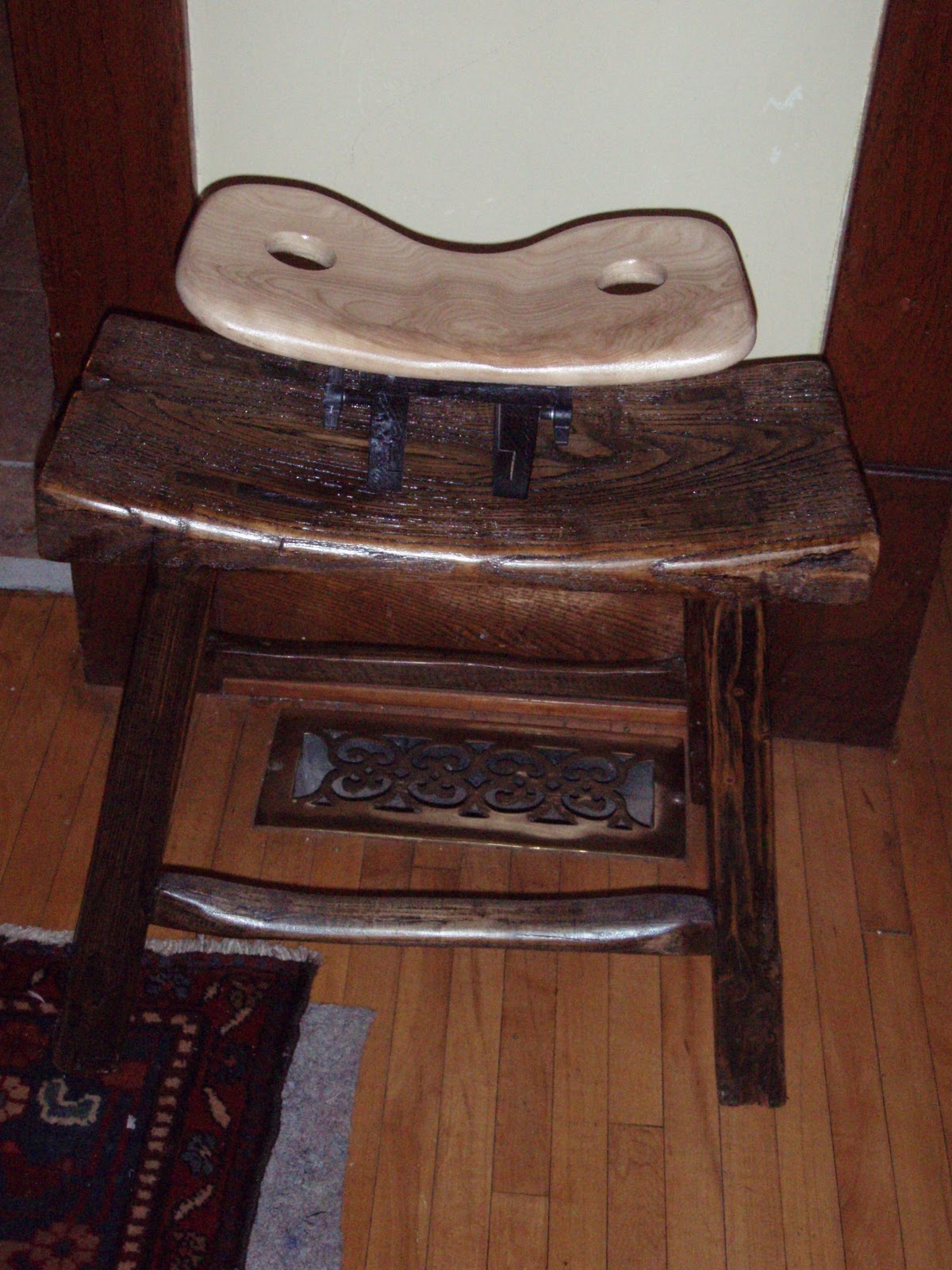
The curved seat inspired from a Chinese stool
Inspiration for these new seats comes from the commercially available racing designs found on the internet, except for one thing. We have a pair of Chinese stools in our living room. The seats are not flat, but gently curved. The curve does a better job of supporting the butt and thus more comfortable. So, I sculpted them from maple along the same curve as the Chinese stool.

My first rowing unit was a sliding seat, a common design which moved forward and aft providing extra leverage with every stroke: nice, but nothing new. Along the way, I also noticed another plus. I could move the sliding seat along the trestle to trim out the boat, especially important when taking on a passenger or even a little gear. On the other hand, there is another design, a sliding rigger which is considerably more efficient.  In the sliding rigger, the seat remains fixed, but the oars and the feet travel along on a second carriage on the trestle. So, I thought, why not incorporate both the sliding seat and the sliding feet into the same unit? The seat would be moved to trim out the boat, then locked in place. Then the "sliding feet" unit could do the rowing.

Side view of the rowing unit
Aft view: the trestle has been extended to incorporate a passenger seat
I'm sure this idea will work. I'm not trying to win any races. I just want to row as far as I can and as long as I can without fatigue and maybe with a friend or two. Speaking of which, I had another inspiration. The sixteen gauge steel poles that form the out riggers are rather awkward when not under way. They make it difficult to pull up alongside another boat or to dock. So I mounted them in such a way as to fold inward with the release of one simple pin.
The outriggers can fold inward for transport or docking
Last, but not least, I paid some attention to the oarlocks themselves. I chose horned oar locks, not the Douglas type. I'm more comfortable with them and find them more versatile. Mounting them took a little thought. I settled on half inch gas pipe tee couplings.  Brass flanges fit nicely inside the tees and just so happened to make perfect sockets for the locks. The tees are sawed down just a little on the bottom so that the oar lock protrudes enough to stick  brass plated linch pins through the little holes on the tips. The linch pins swivel 360 degrees but hold the entire assembly positively in place.
 
Tee couplers, oarlocks, and brass flanges
Oarlocks, brass flanges, and linch pins
The project was easy enough. I had to spend a little on the exercise machine. The most expensive part was getting the steel tubing bent. The local machine shop charged me a hundred and fifty: their minimum. The whole thing weighs about five pounds more, but that's not too bad, considering that it has two seats. Now to build the boat!

Saturday, November 26, 2011

The Metaphysics of Boating or Yup! Melville was right!

...Whenever I find myself growing grim about the mouth; whenever it is a damp, drizzly November in my soul; whenever I find myself involuntarily pausing before coffin warehouses, and bringing up the rear of every funeral I meet; and especially whenever my hypos get such an upper hand of me, that it requires a strong moral principle to prevent me from deliberately stepping into the street, and methodically knocking people's hats off- then, I account it high time to get to sea as soon as I can.


These words come from that great American novel, Moby Dick. Oddly, it's November and I feel the same way. I miss the water! 

Herman Melville was perhaps the first to describe boating as metaphysics. He actually used that word twice in the first chapter.  What does he mean? Perhaps he said it best, "Say you are in the country; in some high land of lakes. Take almost any path you please, and ten to one it carries you down in a dale, and leaves you there by a pool in the stream. There is magic in it."

And just exactly what is that magic?  Well, you don't have to read the whole novel. Just read this from Chris Cross:

Sailing


Well, it's not far down to paradise, at least it's not for me
And if the wind is right you can sail away and find tranquility
Oh, the canvas can do miracles, just you wait and see.
Believe me.

It's not far to never-never land, no reason to pretend

And if the wind is right you can find the joy of innocence again
Oh, the canvas can do miracles, just you wait and see.
Believe me.

[Chorus]

Sailing takes me away to where I've always heard it could be
Just a dream and the wind to carry me
And soon I will be free

Fantasy, it gets the best of me

When I'm sailing
All caught up in the reverie, every word is a symphony
Won't you believe me?

[Chorus]


Well it's not far back to sanity, at least it's not for me

And if the wind is right you can sail away and find serenity
Oh, the canvas can do miracles, just you wait and see.
Believe me.

[Chorus]

You can listen to it if you would like: http://youtu.be/zY2kCJYL1vQ

Chris Cross
  
I love his choice of words: paradise, Never Never Land, tranquility, serenity, innocence, reverie, free, miracles, and especially dream. The feeling of dreaming and the feeling of boating are very similar. On the water, you feel no gravity, only floating and drifting. The dream is a return to a state of innocence, a state of freedom, a way of finding serenity.

Okay, some people never feel that way. They fight the elements. They get sea sick. They can't let go. I know. I often feel the same.

My last trip this season took place in early November. I launched on the Mississippi, at Hidden Falls, just below Lock and Dam #1. The river is narrow here, smaller than the Saint Croix. Kids were playing on the shore nearby. They were skipping stones all the way across. But the current is swift, about 5 MPH.

You have to be diligent, especially in a little dinghy like mine, staying out of the main current and avoiding any snags as well as wakes from the power boats. One little mistake could spell real disaster. You also have to row for all you're worth to make any progress, concentrating on technique, establishing a steady rhythm, etc. Never mind Chris Cross. Boating can be hard work! 

The current picked up as I got closer to the dam. I felt powerless and utterly defeated. So I turned about and headed for home. That's the magic happened. I began to drift. The boat picked up speed and I found myself in the middle of the river, riding on the back of Mother Nature as people of all kinds have done for tens of thousands of years. I was floating, but I could have been flying. My mental state changed accordingly. I had assumed a state of reverie.

And that's the metaphysics of boating. It's not just a journey outward. It's also a journey inward. It is like a dream. You can't help but let go and let the greater world take over. And that kind of letting go can sometimes be the measure of a man.

Okay, dear readers, one more song:
Row row row your boat
gently down the stream
Merrily merrily merrily
Life is but a dream

Wikipedia makes a big deal about the meaning of this little nursery rhyme. You might wish to check it out:  http://en.wikipedia.org/wiki/Row,_Row,_Row_Your_Boat

Perhaps you heard the song, Where to now Saint Peter? by Elton John. It's better known as Blue Canoe:

I took myself a blue canoe
And I floated like a leaf
Dazzling, dancing
Half enchanted
In my Merlin sleep

Crazy was the feeling
Restless were my eyes
Insane they took the paddles
My arms were paralyzed


So where to now Saint Peter
If it's true I'm in your hands
I may not be a Christian
But I've done all one man can
I understand the road I'm on
Where all that was is gone
So where to now Saint Peter
Show me which road I'm on
Which road I'm on


The "blue canoe" is a metaphor for the transition from life to whatever is on the other side. Maybe that's what boat rides are all about! Perhaps they are a subtle reminder of our own smallness and thejourney through life and beyond.

Some time long ago, high in the Himalayas, a famous Dali Lama once said, "Life is a dream that we all agreed to have." Every once in a while it takes a row boat ride to remind me of that. Melville was right. That's the metaphysics of boating!
The Prodigal: somewhere between earth and sky


Sunday, November 13, 2011

The Good Old Days of Boating

I must confess that I enjoy the solitude of boating. I know, of course, that it's a little ironic to be doing that here in the cities. But the words population density mean nothing once you get out on the water. Granted, there are a lot of boats on a Saturday at Lake Calhoun, Lake Harriet, or Lake Nokomis. The rest of the time, however, it's pretty quiet. Quite often I've shared a lake with just one or two die hard fishermen. A funny thing happens when boaters pass by each other. People are friendly, often acknowledging each other with a wave or a nod, seldom by speaking.  I've sometimes thought about the reason for this. It's a matter of courtesy. They respect each other's privacy. Of course, several times I've been completely alone, too.

Bygone days at Lake Como: Once the shore was lined with boats for rent
I rowed Lake Como any number of times this past summer. I live close by. Rarely have I ever seen another boater. Oddly enough, there are about a half a dozen peddle boats for rent. at the pavilion. The park makes them available, but they are seldom used. Meanwhile, the path which surrounds the lake is filled with joggers and strollers. I am frequently stopped by them when I put in or take out. Almost always the comment is something like, "What a good idea!"

Bygone days at Lake Calhoun
Even boating on  Lake Calhoun has seen better days. The photo above shows the opening of the channel to Lake of the Isles. All those canoes! And most of them are filled with more than two people! Granted, this was a special occasion. There were probably lots of dignitaries and a couple of rousing speeches. But even then the point is being made. Any city improvement which involved the sport of boating was an event...and,  judging from the turn out, a big event at that.

Canoe docks at Lake Phalen: What has happened?

Of course, these pictures were taken before the days of high def televisions, X Box, and laptops. And people still take to the parks today. But the culture has changed. A lake is not something to be savored or explored anymore. There is no process of discovery. It has become something to run around. It's a quiet shift in paradigms.

Of course, the way in which we think has changed too. We still have lots of watercraft here in Minnesota, the "boatingest" state in the union. One in six of us owns something that floats. Ninety percent of them have something with a motor attached. You can see them trailering out of town on I94 on any given Friday afternoon.

Personally, I'm not sure if all of those power boaters are really "getting away from it all," or having a big adventure with all of the other power boats. The Lower Saint Croix, for example, gets pretty crowded on the weekends. I think it's much quieter right here in town!